When the Uniform Runs
The institution hasn't collapsed. The uniform is still being worn. Something else has left.

There is a moment in disaster films that functions as a kind of cultural shorthand. You have seen it a hundred times without necessarily registering it as a device. The city is flooding, or burning, or collapsing, and in the background - not the foreground, that is important - a police officer removes his badge and walks in the other direction. A soldier drops his rifle and joins the crowd of civilians running away. A firefighter sits down on the curb, helmet off, staring at nothing.
The director does not linger on this. It is two seconds, maybe three. But the audience understands immediately what it means. The institution has failed. Not the building, not the infrastructure, not the government in the abstract. The human beings who were supposed to hold the line have decided the line is not worth holding. That is the point of no return. Everything that comes after is aftermath.
I have been thinking about this a lot lately. Because I think it is happening in real time, and I think most people watching do not have the vocabulary to name what they are seeing.
The United States military and intelligence apparatus is not collapsing. Let me be precise about that, because the argument I am making is more specific than collapse.
The institution is intact. The buildings are standing. The budgets are enormous. The weapons work. What is being lost is something harder to measure and harder to replace: the willingness of the institution’s own people to believe in what they are doing.
Consider the inventory.
General C.Q. Brown, Chairman of the Joint Chiefs of Staff, fired in February 2025 via social media post. His offense was unclear. His replacement was more compliant. General Timothy Haugh, director of the NSA and commander of Cyber Command, fired the same week. Career CIA analysts have left in numbers that the agency does not publish but that former officials describe, uniformly, as unprecedented. The State Department has lost institutional memory at a pace that foreign service officers compare to a controlled demolition.
These are not people who removed their badges and walked away. They were pushed. But the effect on the institution is the same as the film moment: the people who knew what they were doing are gone, and the people who replaced them were selected for a different quality entirely.
That quality is not competence. It is agreement.
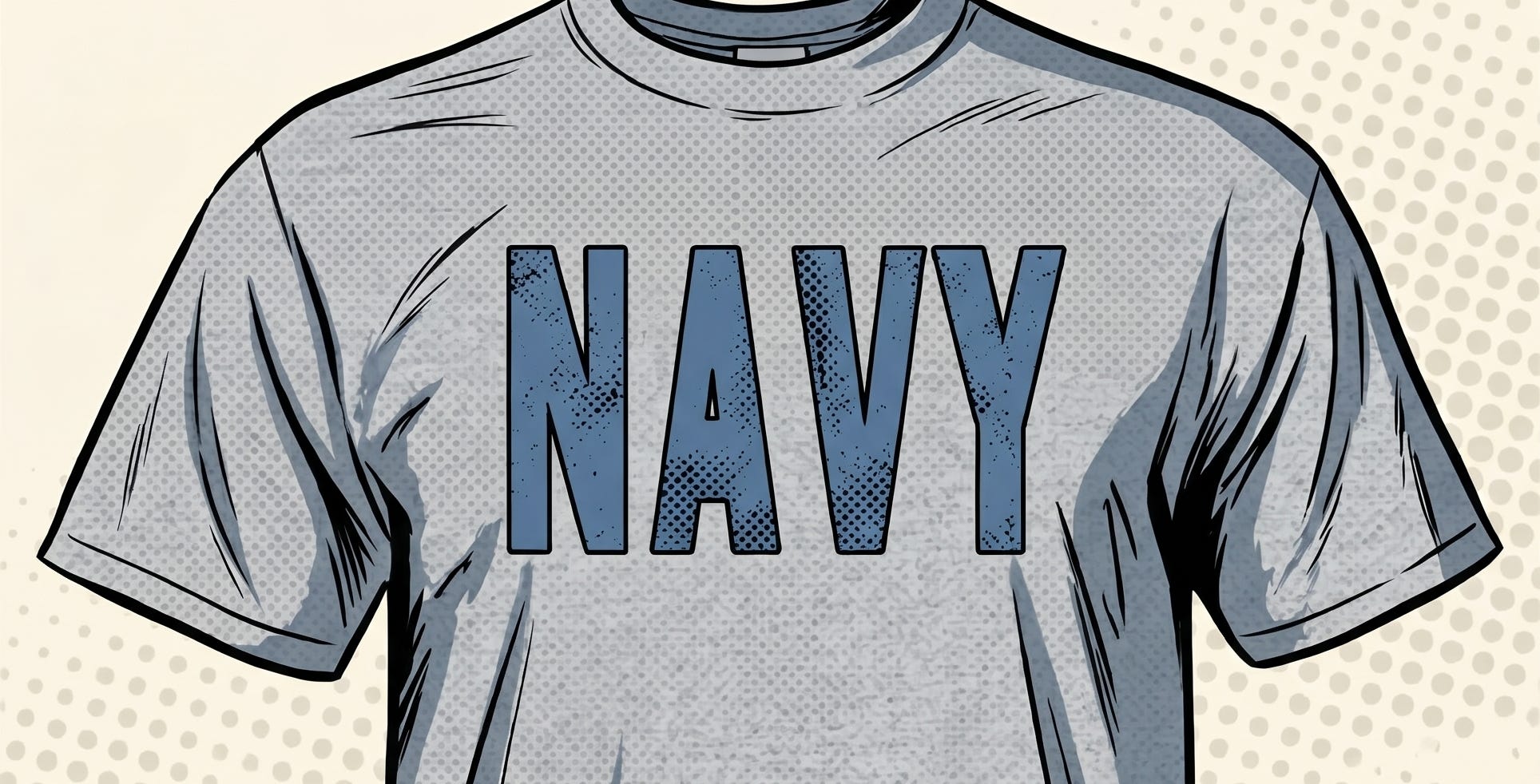
I want to talk about a gray gym t-shirt.
I bought it on a US naval base in the Mediterranean, sometime in my mid-twenties, when I was still serving in the German Navy on a fleet service vessel attached to the 1st Submarine Squadron. It was one of those things you acquire without thinking - not a souvenir, exactly, more like a small proof that something was real. That you were there, that the alliance existed, that the people on the other side of it were worth standing next to. The cotton wore thin over the years. The blue lettering started to crack.
I wore that shirt for years. Last month it finally went into a drawer. I am not sure I will wear it again.
This is my version of the film moment. Not dramatic, not public. A gray t-shirt in a drawer that represents something I believed in that I am no longer sure I believe in the same way. Not the people - I still think about the American sailors and soldiers I served alongside with genuine respect. But the institution they served, and the people now running it, have become something I do not recognize.
Pete Hegseth - I will use his chosen title, Secretary of War - has never commanded anything under fire. He has commentated on it, from television studios, with a good haircut. He now runs the largest military apparatus in the history of the world. He fires people who disagree with him. He holds prayer sessions at the Pentagon during working hours. He renamed his department after his own fantasy of what power looks like.
The professionals below him are still there. They still know their jobs. But they are receiving orders from someone who does not understand what those jobs are, and in some cases does not want to understand, because understanding would complicate the performance.
That is the cue. That is when the uniform runs.
There is a version of this that is purely institutional and a version that is personal, and I think the most honest writing lives at the intersection.
The institutional version: when an organization systematically removes the people who tell it things it does not want to hear, it loses the capacity to function in reality. It can still function in performance. It can still hold press conferences, publish doctrine, deploy assets, issue statements. But it has lost the feedback mechanism that connects action to consequence. The organism stops learning. And organisms that stop learning die, or cause enormous damage on the way to dying.
I got drunk once with a US Army general in Rome. A good evening, built on shared professional language, until the language stopped working. At some point I understood he was a Trump man - not politically, in the abstract, but genuinely, bones-deep. And I couldn’t find my way back to the night after that. Not because of politics. Because flag officers are supposed to be Hornblower. They are supposed to carry the weight of history and professional judgment and institutional responsibility in a way that transcends the politics of the moment. Trump is the anti-Hornblower. He is the thing the institution exists to protect against. That a three-star general could not feel that dissonance, could not recognize it as a violation of everything his uniform represented - that told me something I did not want to know.
The t-shirt had been heading for the drawer since that night. Last month it got there.
When that happens - when the uniform walks away - the people around them notice. Not because the departure is loud. Because the presence was, until that moment, a kind of anchor. The institution, embodied in a uniform, had been telling everyone around it: this is manageable, there is a structure, the structure holds. When the uniform leaves, that reassurance goes with it.
I am not saying American military officers are leaving their posts. Most of them are not. They are professionals and they understand duty and they will continue to do their jobs. What I am saying is that something else has left. The thing that made the uniform mean what it used to mean. The institutional confidence that what you were doing was grounded in something real, accountable, and worthy of the sacrifice it requires.
It does not look like a press release when an allied service loses faith in its American counterpart. It looks like hesitation. It looks like a German or British intelligence officer pausing before hitting send on a classified intercept, wondering whether the political appointee at the other end of the pipeline will use it for the mission or for a performance. That pause is new. A year ago it was not there. It is there now.
That thing left when the Secretary of War fired the Chairman of the Joint Chiefs via social media. It left a little more when the FBI director nearly blew the cover of allied intelligence officers for a photograph. It left a little more every time a career professional was replaced by a loyalist who had never done the job.
You cannot see it on the surface. The uniform is still being worn. The ranks are still being saluted. The aircraft carriers are still in the water.
But something is different. The people who know the difference know it. The allies who have worked alongside this institution for decades know it. And somewhere, in whatever planning rooms Beijing and Moscow maintain, someone knows it too. They are not afraid of the hardware. The aircraft carriers are still in the water.
What they track is the cognitive decline of the command structure - and they do not need to defeat an institution that is already purging its own competence. They just have to wait for the structurally fatal mistake.
I bought that t-shirt because I believed the institution it represented was worth standing next to. Not perfect - America’s military history contains chapters that honest people should read with discomfort. But serious. Grounded in something real. Capable of self-correction. Worthy, in the net, of the trust that allied nations placed in it.
I am not sure I believe that in the same way anymore. Not because the people in it have changed. But because the people running it have changed what it is being used for.
The institution has not collapsed. The uniform is still being worn.
But in the background, if you know what to look for, someone is walking the other way.
FJGR